How to survive a nuclear attack

If the worst happened, you'd know what to do.

Fallout Ready turns public guidance from FEMA, Ready.gov, the CDC and Lawrence Livermore National Laboratory into step-by-step checklists for the first minutes, hours and days of a nuclear attack: at home, at work, driving or outside.

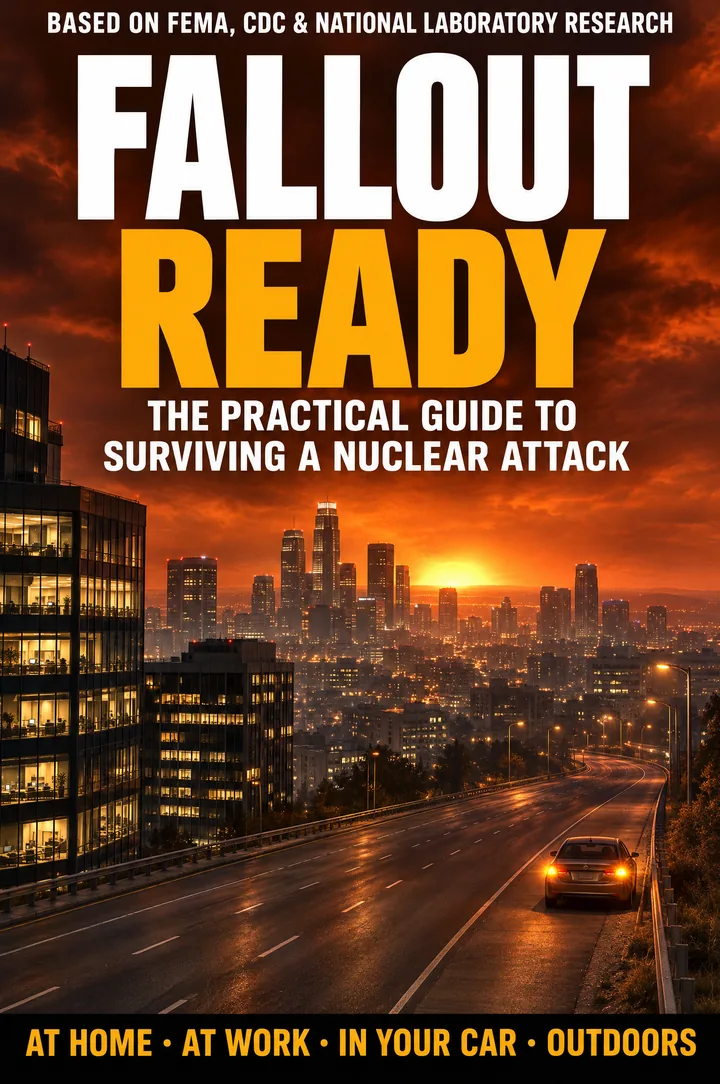
Cover of Fallout Ready: The Practical Guide to Surviving a Nuclear Attack
Read chapter 1 free
  • 61-page PDF + EPUB
  • Instant download
  • 14-day refund

Why now: since 2024 the EU and six European governments have asked households to be able to cope alone for the first days of a crisis. Read their words

Built on public guidance from FEMA, Ready.gov, the CDC and Lawrence Livermore National Laboratory. Named as sources only: Fallout Ready is independent, and no agency is affiliated with it or endorses it.

How the guide works

The book follows the clock.

Each scenario chapter runs in the same order, so you can find your place quickly under stress: the first 60 seconds, the first 10 minutes, the first 24 hours. Then the book carries on to two weeks.

  1. 60 secondsSurviving the flash and blast

    Drop face down, away from windows, behind anything solid. Stay down until the blast wave has passed.

  2. 10 minutesReaching shelter before fallout arrives

    Get into the best building you can reach: a basement, or the middle of a large brick or concrete building. A car is not a shelter.

  3. 24 hoursStaying protected

    Stay inside, seal up, strip and wash, stay tuned. Radiation from fallout drops by about 90% in the first 7 hours.

  4. 14 daysLiving in shelter, and being ready for it

    Water, food, sanitation and information while services are disrupted, plus the home kit and go-bag lists to prepare in advance.

Why now

Governments now ask households to cope alone for the first days.

Since 2024, one government after another has asked ordinary people to keep enough at home to manage without help at the start of a crisis: 72 hours in most countries, a week or more in some. These are their words, with links to the originals.

  1. European Union. The Commission's non-binding guidelines ask civil-protection authorities to “promote at least 72 hours of self-sufficiency as a minimum baseline”.

    Commission communication C(2026) 8250 ↗
  2. United Kingdom. The Cabinet Office launches Be Ready, with “the advice to be prepared for three days of disruption” at its heart. On its checklist: “Bottled water for 3 days” and “Non-perishable food for 3 days”.

    GOV.UK ↗
  3. France. The government guide Tous responsables recommends an emergency kit, kept within reach, giving everyone “72 heures d'autonomie”: 72 hours of self-sufficiency.

    info.gouv.fr ↗
  4. Netherlands. The government announces a booklet for more than 8.5 million households, so that people can manage “de eerste 72 uur”, the first 72 hours.

    Rijksoverheid ↗
  5. Germany. The federal civil-protection office BBK reissues its household guide. Its advice: be able to supply yourself for “möglichst zehn Tage”, ideally ten days; even “zumindest drei Tage”, at least three days, helps a great deal.

    BBK ↗
  6. Sweden. The brochure In case of crisis or war goes out to households. The civil-defence agency's standard: “being able to manage on one's own for at least a week”.

    Swedish Civil Defence and Resilience Agency ↗
  7. Norway. The civil-protection directorate DSB raises its advice “from at least three days to one week”, then posts a brochure to every household.

    DSB ↗

What these campaigns are, and what they are not

They are all-hazards campaigns: power cuts, floods, cyber attacks, conflict. They are not warnings that a nuclear attack is coming. The Commission's own guidance describes preparedness as “a precautionary measure based on a changing risk environment, not a response to a specific or immediate threat”. We take the same view and make no prediction.

What they share is a principle: in the first days, help goes to the people in greatest need and everyone else looks after themselves. The official advice for those days is a short list. Fallout Ready takes the hardest scenario, the one a household leaflet has little room for, and works through it in practical detail. Its stockpiling chapter builds a 14-day home kit made mostly of what the book calls “ordinary emergency supplies that also cover storms, power outages and other disasters”.

No government asked for this book, and none endorses it.

Free sample

Read chapter 1 now. All of it.

This is the whole of Chapter 1, word for word. If you never buy the book, you will still have read the part that matters most.

Codes in square brackets point to the reference list in Appendix B.

Fallout Ready

The 60-Second Version

If you read only one page, read this one.

GET INSIDE. STAY INSIDE. STAY TUNED.

1. If you see a blinding flash: drop. Get down immediately, face down, away from windows, behind anything solid. Cover exposed skin and your head. Stay down until the blast wave has passed. It can take several seconds to arrive, or longer if you are far away.

2. Get inside within about 10 minutes. Fallout (radioactive dust) usually takes 10 minutes or more to reach areas outside the blast zone. Use that time to get into the best building you can reach: a basement, or the middle of a large brick or concrete building. Any building is better than outdoors. A car is not a shelter.

3. Go deep. Inside, go to the basement or the center of the building, away from outside walls, windows and the roof. Put as much concrete, brick, earth and walls between you and the outside as you can.

4. Strip and wash. If you were outside after the blast, take off your outer layer of clothing carefully (this removes up to 90% of contamination), bag it, and wash with soap and water. No conditioner.

5. Seal up. Close windows, doors and fireplace dampers. Turn off fans, air conditioning and heating that draws in outside air.

6. Stay inside at least 24 hours unless there is fire, a gas leak, building collapse, or officials tell you otherwise. Radiation from fallout drops by about 90% in the first 7 hours and about 99% in two days.

7. Stay tuned. Use a battery or hand-crank radio, phone alerts, or TV to follow official instructions. Text, don't call.

8. Do not go out to collect family members. Schools and workplaces have plans. Going outside exposes you and them.

Sources: [READY-RAD], [CDC-INSIDE], [CDC-DECON], [FEMA-PG], [G&D-1977].
What's inside

61 pages. Twelve chapters. Two appendices.

  1. 1

    The 60-Second VersionThe whole plan in eight steps. Free to read above.

  2. 2

    What Actually HappensFlash, blast, fire, fallout. FEMA's damage zones, the 7:10 rule, and why buildings protect you.

  3. 3

    Choosing a ShelterProtection factors from a car (1.7–2) to an underground garage; ranked options; where to sit inside.

  4. 4

    You Are at HomeWith or without warning. Which room. What to do if someone knocks.

  5. 5

    You Are at WorkOffices, shops, factories, schools. Organising a group that can't go home.

  6. 6

    You Are DrivingWhy to leave the car, and what to do if no building is in reach.

  7. 7

    You Are Walking OutsideThe most exposed position, including with children.

  8. 8

    DecontaminationThe seven-step routine at the door. Pets, food containers, helping others.

  9. 9

    Living in ShelterThe first day to two weeks: water, food, medication, sanitation, information, morale.

  10. 10

    Leaving Shelter and RecoveryWhen to leave, how to evacuate when told to, health afterwards.

  11. 11

    Stockpiling in AdvanceThe 14-day home kit, go-bags for car and workplace, a family plan and a maintenance schedule.

  12. 12

    Myths vs FactsEleven common beliefs corrected, from iodine pills to driving away.

  13. A

    Printable ChecklistsWallet card, fridge sheet for your family plan, stockpile checklist.

  14. B

    SourcesAll 14 references, with links to official guidance pages.

From Appendix A: the wallet card

IF YOU SEE A NUCLEAR FLASH
  1. 1. DROP face down. Cover head. Away from glass. Wait for blast.
  2. 2. GET INSIDE within ~10 min. Basement or center of a brick/concrete building. Not a car.
  3. 3. STRIP outer layer at the door. Bag it. WASH with soap. No conditioner.
  4. 4. SEAL: windows, doors shut. Fans and AC off.
  5. 5. STAY INSIDE at least 24 hours.
  6. 6. STAY TUNED: radio, alerts. Text, don't call.
  7. 7. DON'T go get family. DON'T take KI unless told.

From Chapter 6: three of its five do-nots

Absolutely do NOT
  • Do NOT keep driving while flash-blinded. Stop.
  • Do NOT treat your car as a shelter if any building can be reached in the 10-minute window [READY-RAD; LLNL-2009].
  • Do NOT drive toward ground zero or into the path of the cloud, for any reason.

Every scenario chapter ends with common mistakes and a box like this one.

How it's different

More than a leaflet. Calmer than a bunker manual.

Free government pages

Organised by
Hazard and agency, across many pages and PDFs
Goes as far as
The essentials: get inside, stay inside, stay tuned
Sources
They are the source. Always check them.
Tone
Neutral and brief

Fallout Ready

Organised by
Where you are: home, work, car, on foot
Goes as far as
Step by step from the first 60 seconds to two weeks, with common mistakes and do-nots
Sources
Source codes in the text, a source list closing every chapter, 14 references in Appendix B
Tone
Calm and specific. It says what it can't promise.

Alarmist prepper books

Organised by
Often gear, bunkers and worst cases
Goes as far as
Long-term survivalism most households will never use
Sources
Often thin or missing
Tone
Urgency sells

The honest version: everything in this book comes from public sources, and all of them are listed in Appendix B. You could assemble it yourself. What €9.99 buys is the assembly: one document, organised by where you are, with the practical detail filled in.

Who it's for

A plan, not a hobby.

It's for you if

  • You have no prepping background and want a calm, credible plan.
  • You've seen your government's 72-hour advice and wondered about the worst case.
  • Other people rely on you: children, parents, staff.
  • You'd rather read 61 pages once than keep scrolling through alarm.

It's not for you if

  • You need official instructions. Your civil-protection authority always comes first, and its advice is free.
  • You want blast maps for your city. The book makes no city-specific predictions.
  • You want guidance on power-plant accidents or “dirty bombs”. Those are different events with different advice.
  • You want bunker plans or long-term survivalism.
Fallout Ready cover

The guide

Fallout Ready

What to Do in the First Minutes, Hours and Days of a Nuclear Attack

  • PDF, 61 pages, 6 × 9 in, print-friendly
  • EPUB that reflows on phones, tablets and e-readers
  • Printable wallet card, family-plan fridge sheet and stockpile checklist
  • 14-day refund, no questions asked
€9.99One payment, VAT included.
No account, no subscription.

Questions

Asked before buying.

Who wrote this?

Fallout Ready is published by Electronic Products. It was researched and drafted with the assistance of AI tools, then checked against the sources listed at the end of each chapter and in Appendix B. We don't claim a doctor, physicist or emergency official as its author. That is why the source codes are there: you can check any instruction against the original.

Is this official advice?

No. It is general educational information drawn from public sources, principally FEMA, Ready.gov, the CDC and Lawrence Livermore National Laboratory. We are not affiliated with any government agency and none endorses this guide. In a real emergency, instructions from your own authorities always come first.

Are you saying an attack is likely?

No. We make no prediction, and nothing on this page should be read as one. The book exists because the official advice is short and the practical questions are not.

I live in Europe and the sources are American. Does it still apply?

The protective actions (get inside, go deep, stay inside, wash off contamination) rest on physics that is the same everywhere. The details are American: gallons, miles and feet come first, with litres alongside for the water quantities, and it mentions US services such as NOAA Weather Radio and the FEMA app. Appendix B lists official guidance pages for the UK, Canada and Australia and refers EU readers to their national civil-protection authority. Where your authority says something different, follow it.

Why pay when government advice is free?

You don't have to. Every source is public and listed in Appendix B. You pay for the work of turning them into one document organised by where you are, with the steps, the common mistakes and a complete stockpile list.

What exactly do I get?

One purchase, two files: a 61-page PDF (6 × 9 in, print-friendly) and an EPUB for phones, tablets and e-readers. Download links appear as soon as payment clears and are emailed to you. No account, no subscription.

Can I print the checklists?

Yes. Appendix A has a wallet card, a fridge sheet for your family plan, and a stockpile checklist sized for a family of four over 14 days.

Does it cover power-plant accidents or dirty bombs?

No. It covers a nuclear weapon detonation. A nuclear power plant accident or a radiological “dirty bomb” is a different event with different advice; for those, follow official instructions.

What if it isn't what I expected?

Reply to your receipt email within 14 days and we refund the full €9.99. No questions asked.

Will following it keep me safe?

No guide can guarantee survival, and this one says so in its opening disclaimer. It sets out the actions that official planners and scientists consider most likely to reduce injury and radiation exposure for people outside the immediate area of destruction.

Read it once. Print the card. Get on with your life.

61-page PDF + EPUB · instant download · 14-day refund

Fallout ReadyPDF + EPUB · €9.99